
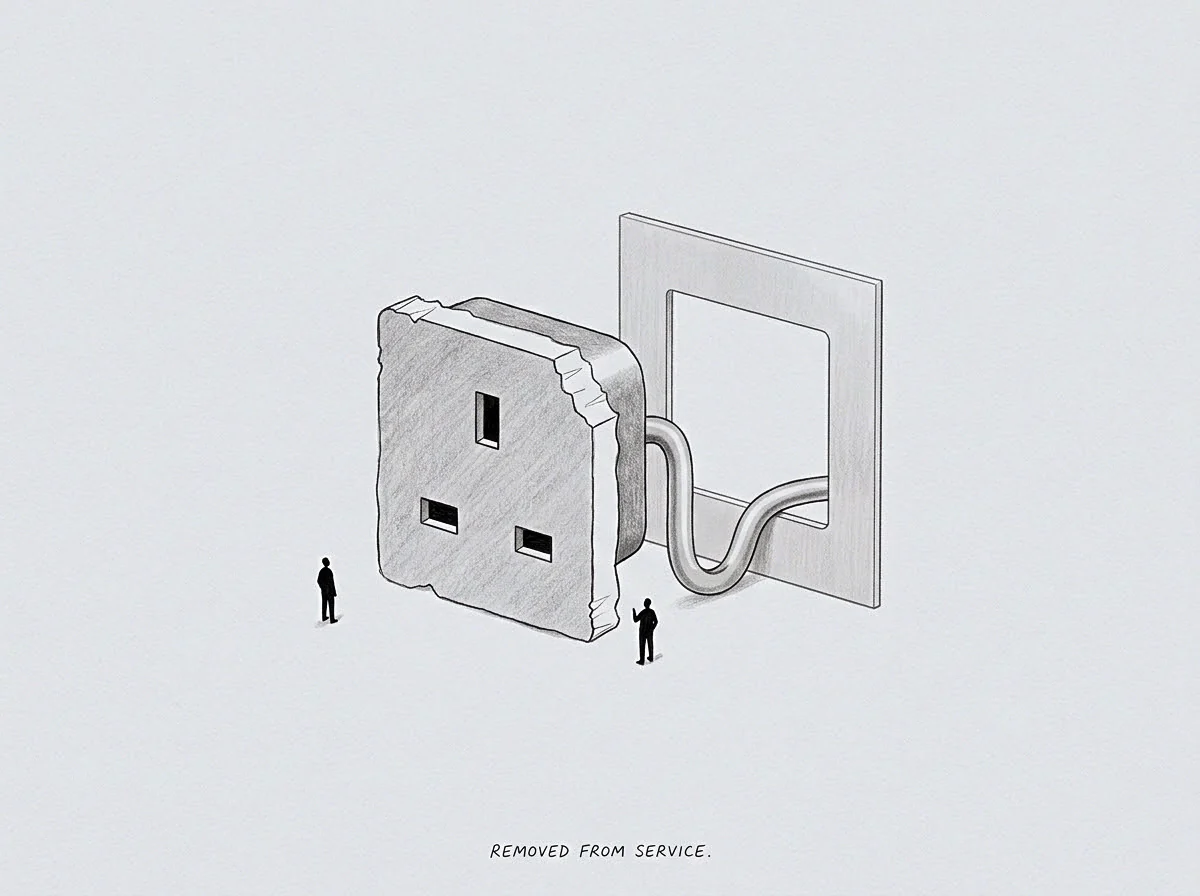
Adrenal Baseline Recovery After Governance Threat Removal
Adrenal baseline recovery lags legal resolution because prolonged threat downregulates cortical receptor sensitivity and depletes basal endocrine reserves.

Allostatic load is the wear of regulating for others through a period when one’s own load is at ceiling. Throttling is regulation running at its limit; the depression reading is regulation failing, and the two are different states. The concurrency limit counts ungated threads, never projects.

Adrenal baseline recovery lags legal resolution because prolonged threat downregulates cortical receptor sensitivity and depletes basal endocrine reserves.

Allostatic load clearance in former executive leaders requires hard structural limits on active ungated threads to restore prefrontal headroom.

Executive departure produces delayed parasympathetic activation because the central nervous system maintains autonomic vigilance long after structural authority ends.

Executive role departure triggers autonomic recalibration when chronic sympathetic tone drops, unmasking accumulated allostatic load and parasympathetic rebound.
The brain budgets regulation as if a reliable other is present. Self-regulation alone is the expensive mode and proximity is the cheap one, which is why people attach to a stable person’s state and read the borrowed calm as their own. A regulator proven under load attracts more load.

Solitary executive decision making elevates baseline metabolic expenditure because the brain processes isolated authority as a continuous environment of threat.

Solitary leadership roles remove biological co-regulation cues, shifting threat management to expensive self-regulation and driving allostatic load.
Executive teams navigating insoluble corporate debt experience severe biological exhaustion that degrades cognitive function, requiring structural throttling to restore regulatory capacity.

Enterprise solvency under financial strain transfers organizational volatility directly into executive allostatic load when leaders lack shared regulation anchors.
A stated limit is a wall, not a person: a load-transferring system pushes until it meets something that is not the regulator. Availability lives in the silence of a position and a cost. The channel that does not ping was not a priority for either side.


Executive processing lag occurs when arrival rates exceed cognitive clearance limits, requiring stated structural walls to drop secondary operational queues.

Unstated partner friction shifts emotional load into corporate burn rate, depleting cash reserves through compensatory spending and delayed decisions.

Depleted leadership teams fail at high-friction decision points because biological state exhaustion overrides cognitive capacity and forces default choices.

Executive strain compresses capital allocation horizons by elevating discount rates and forcing state-gated preferences toward immediate capital payback.
The terms are written where they belong. Each field holds three desks, and every entry a desk writes raises the terms it uses, each term given a meaning, a mechanism and the places it appears. The record on these pages stays first person and hand made; the fields grow the nomenclature.