
The Somatic Cost of Sustaining Enterprise Solvency Under Allostatic Load
Enterprise solvency under financial strain transfers organizational volatility directly into executive allostatic load when leaders lack shared regulation anchors.

Core
Payroll sits three business days away while enterprise liquidity reserves dip beneath the mandatory sixty-day operating threshold. Four executive team members log into a late-night status call, watching the leadership video feed for unspoken signals regarding company stability. The central nervous system processes the convergence of balance sheet depletion and human dependency as a continuous threat environment, initiating a cascade of neuroendocrine events.
Cortisol production remains elevated across sixteen consecutive hours, while heart rate variability drops to half its historical baseline. The body sustains precise articulation, steady vocal modulation, and coherent strategic projection while metabolic resources deplete in real time.
Human stress biology operates on an energy distribution framework designed for acute, time-bounded physical threats. Under prolonged organizational instability, the human organism shifts into allostatic load, an ongoing physiological state where cardiovascular, metabolic, and neural systems alter their operating baselines to accommodate continuous strain. When solvency concerns extend over quarters rather than days, the nervous system maintains active sympathetic activation, suppressing cellular repair, digestion, and restorative sleep cycles.
Enterprise survival shifts from an economic objective to a physical consumption of internal tissue and neurological bandwidth.
Social baseline theory establishes that physiological load decreases when a reliable human partner shares threat monitoring and regulation.
Social baseline theory demonstrates that the human mammalian nervous system uses environmental and social proximity to economize internal energy expenditure. When a person believes a competent peer shares direct responsibility for surviving a financial crisis, the brain budgets neural computation and endocrine responses at lower baseline effort. Operating as the sole regulatory anchor for an organization forces the brain into maximum independent calculation.
The body treats isolated accountability for enterprise survival as an unmitigated physical exposure, escalating energy consumption to keep autonomic functions stable.

Autonomic Baseline Adjustments Under Persistent Solvency Pressure
Continuous operational distress rewires how the brain measures risk and allocates biological energy. The anterior cingulate cortex continuously monitors the distance between liabilities and available capital, projecting survival probabilities across rolling ninety-day windows. Extended exposure to high operational ambiguity forces the autonomic nervous system to raise resting muscular tension and maintain elevated circulating catecholamines.
Over time, the internal reference point for safety resets downward, rendering normal restful states inaccessible even when business liquidity temporarily stabilizes.
The metabolic price of sustaining this state shows up across specific biological systems over predictable timelines. Cardiovascular markers reflect sustained vasoconstriction, raising resting blood pressure while blunting normal vagal recovery after acute events. Sleep architecture reorganizes, eliminating deep slow-wave recovery phases in favor of persistent light sleep optimized for sudden waking responses to night pings.
Prolonged suppression of immune activity leads to systemic low-grade inflammation, manifesting as joint pain, executive memory fatigue, and delayed physical repair cycles. Sustaining financial solvency through continuous somatic over-allocation converts executive stamina into structural organ strain.

Asymmetry
Organizational structures naturally concentrate emotional and operational reliance onto executive leaders during financial drawdowns. Team members, suppliers, and board members continuously read the leader’s facial expressions, vocal cadences, and response latency to gauge their own security within the venture. The executive absorbs incoming ambient panic from stakeholders while projecting composure, acting as an autonomic sink for the surrounding organization.
This process requires continuous active inhibition of the leader’s own fear responses, doubling internal metabolic consumption.
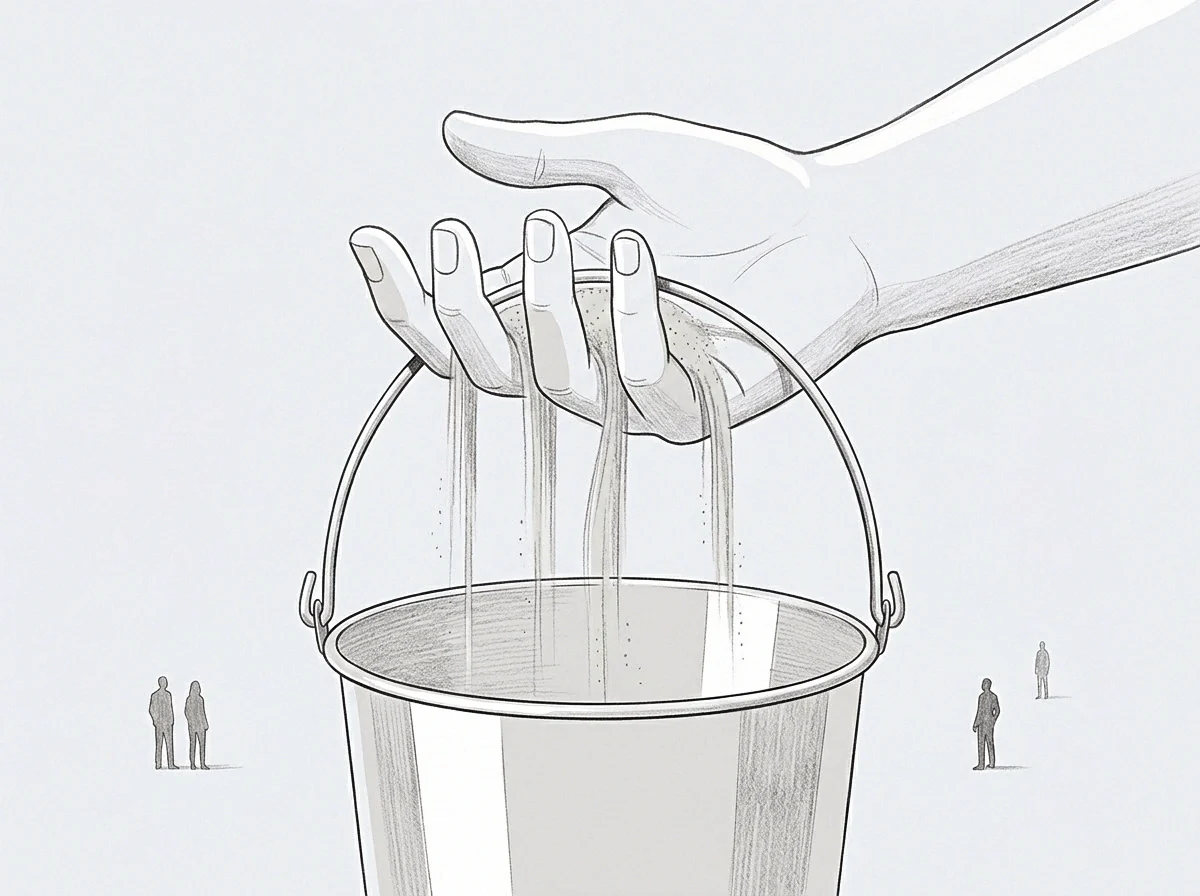
The dynamic creates an asymmetric regulatory load where multiple individuals borrow physiological stability from a single source. Human neural networks co-regulate through mirror neuron activation and subtle behavioral matching, allowing team members to lower their internal threat responses simply by interacting with a steady presence. When the executive lacks an external human anchor from whom to borrow regulation, their internal system operates at a continuous deficit.
The team registers calm and continues working, while the leader’s internal template drains without replenishment.
- Borrowed Regulation occurs when team members stabilize their nervous systems by anchoring to a calm executive, transferring somatic burden upward without compensating operational support.
- Empty Receptor Slots describe the internal structural absence where a leader has no relational space to receive incoming co-regulation from a competent, reliable peer.
- Autonomic Throttling happens when the nervous system deliberately dampens physiological emotional expression to prevent organizational panic, increasing internal cardiovascular tension.
- Covert Regulatory Contracts form when employees trade operational compliance for continuous emotional reassurance, binding company stability directly to the founder’s somatic endurance.
This dynamic operates largely without explicit conversation or mutual agreement. Team members interpret steady leadership behavior during solvency threats as evidence of unlimited internal capacity, escalating their demands for access, decision sign-offs, and emotional anchoring. The leader experiences an increasing isolation, recognizing that showing genuine panic or somatic collapse would trigger immediate organizational fragmentation.
The arrangement transfers company volatility directly into the leader’s cellular biology.

The Regulator Template and Internal Working Models
Early developmental experiences and professional conditioning shape how an individual responds to organizational strain. Leaders who internalize early operational patterns where personal safety depended on anticipating and managing the emotional states of others carry a specific regulator template into corporate governance. This working model frames personal vulnerability as dangerous, defining safety exclusively through total environmental control and constant caretaking of external stakeholders.
In high-stakes solvency situations, this template operates automatically, driving the leader to absorb rising enterprise risk without requesting structural assistance. The internal architecture lacks a receptor slot for receiving support, treating external offers of help as potential operational threats or added management burdens. The leader continues to provide borrowed regulation to the company until physical collapse forces an abrupt operational shutdown.
“The company was completely fine on Tuesday, so we had no idea the executive was facing medical collapse on Wednesday.”
Scale
Sustaining enterprise solvency under allostatic load varies across operational models, capital structures, and leadership distribution choices. An organization managed through centralized autonomic control exhibits different physiological costs than one governed through shared accountability structures. The operational trade-offs determine whether stress consolidates into one body or distributes across the operational ecosystem.
| Evaluation Dimension | Centralized Autonomic Solvency | Distributed Structural Solvency |
|---|---|---|
| Regulatory Burden Location | Consolidated entirely within the chief executive nervous system | Distributed across executive team through binding operational governance |
| Somatic Energy Expenditure | Continuous peak sympathetic output with rapid cellular depletion | Modulated autonomic expenditure with structured recovery windows |
| Organizational Risk Dependency | High single-point failure potential upon executive health impairment | Resilient operational redundancy across independent leaders |
| Information Processing Speed | Rapid single-brain execution coupled with high cognitive bias risk | Deliberate multi-perspective review with built-in stress validation |
| Long-Term Enterprise Solvency | Vulnerable to sudden leadership incapacitation during cash crunches | Sustained through formal capital reserves and shared operational limits |
Consider a venture-backed technology enterprise managing a twelve-month runway extension during a market downturn. In a centralized setup, the founder conceals cash burn realities from department heads, managing all vendor payment deferrals and payroll balancing personally. The founder spends four hours each night running financial survival permutations while maintaining an optimistic tone during morning staff meetings.
Within six months, the founder develops severe gastrointestinal distress, cardiac arrhythmias, and cognitive fatigue that slows critical decision-making.
Setting explicit operational limits on personal availability alters the organization’s reliance on executive somatic absorption.
Contrast this with the same venture utilizing a distributed structural solvency model. The founder presents clear runway metrics to department leads, establishing formal monthly expenditure limits and co-owning cash preservation targets with the executive team. Financial survival becomes an engineering challenge managed through transparent metrics rather than a personal emotional burden carried alone.
The somatic cost to the founder drops, preserving cognitive clarity necessary to execute strategic maneuvers required to reach profitability.

Operational Throttling as an Emergency Circuit Breaker
When allostatic load approaches biological limits, the central nervous system enforces involuntary protective measures. These systemic interventions include sudden executive apathy, severe depressive shut-down, panic episodes, or acute physical illness that physically prevents work engagement. The body deploys autonomic throttling to force rest when voluntary cognitive controls refuse to step back from ongoing solvency threats.
Recognizing the onset of involuntary throttling allows organizations to restructure governance before systemic failure occurs. Implementing strict operational boundaries, such as mandatory off-grid recovery blocks, dual-signatory financial authorities, and explicit crisis delegation protocols, shifts enterprise survival from somatic endurance to systemic design. A stated limit on executive weekly work hours redefines solvency management from personal heroism to sustainable resource allocation.

Friction
A central dispute within occupational health and executive governance centers on whether somatic recovery is possible while maintaining active control of a financially distressed enterprise. One perspective asserts that cognitive reframing, mindfulness techniques, and micro-rest protocols allow leaders to sustain extreme allostatic loads indefinitely without changing corporate structures. This view treats human resilience as a trainable mental capacity that can scale alongside enterprise complexity.
The opposing perspective, supported by physiological data, maintains that biological systems have absolute energy limits that cannot be bypassed through psychological techniques. Continuous autonomic arousal under existential financial threat inevitably consumes physical tissue regardless of mental discipline. Proponents of this view argue that enterprise solvency achieved through executive physical destruction represents an unviable business model that merely offloads financial liabilities onto human biology.

Is Somatic Recovery Possible Without Enterprise Restructuring?
Clinical tracking of human stress physiology under continuous threat suggests that psychological reframing offers limited protection against sustained neuroendocrine activation. When the balance sheet presents an authentic threat to operational survival, the primitive survival structures of the brain react to objective risk parameters rather than deliberate positive thinking. Autonomic regulation requires tangible reductions in threat exposure or physical co-regulation from reliable partners.
- The organization identifies clear financial indicators that trigger automatic operational adjustments rather than relying on executive emotional endurance.
- Governance procedures establish shared financial accountability, ensuring no single individual acts as the sole emotional cushion for enterprise debt.
- Communication protocols eliminate continuous off-hours threat monitoring, giving the autonomic nervous system structured windows of true safety.
- Executive incentive structures align enterprise survival with long-term leadership physical capacity rather than short-term cash preservation.
Uncertainty remains regarding the precise threshold where allostatic load converts from reversible fatigue to permanent cardiovascular or neurological damage. Individual variation in genetic stress tolerance, historical regulator templates, and personal relational support networks makes predicting exact human breaking points difficult. Organizations operating under high ambiguity must decide whether to optimize for maximum short-term financial leverage or long-term leadership sustainability.
Resolving this tension requires defining clear boundaries between human energy allocation and enterprise resource demands.

Cord
Updating an established regulator template requires moving beyond intellectual insight into deliberate physical and operational choices. A founder who understands the biological cost of allostatic load still defaults to solo regulation during an acute cash crisis unless concrete operational structures enforce a different path. Transitioning to earned security involves repeatedly experiencing shared risk management with competent peers under actual high-stakes conditions.
This structural update begins by altering the physical and relational parameters of decision-making. Introducing transparent financial reporting to board members and department heads removes the isolation that drives extreme somatic expenditure. Establishing formal co-leadership models creates concrete mechanisms for shared autonomic regulation, providing the nervous system with authentic evidence that enterprise survival does not rest on a single body.
True security develops when an executive repeatedly tests shared accountability and discovers the enterprise remains solvent.
Over time, the delta between perceived existential threat and actual operational risk narrows. The nervous system unlearns the habit of treating every cash flow fluctuation as an immediate somatic emergency, returning resting physiological markers to healthy baselines. Vagal tone improves, deep sleep patterns return, and cognitive flexibility restores, allowing for more strategic decision-making during ongoing business challenges.
Building sustainable enterprises requires recognizing that human nervous systems are finite physical assets essential to long-term organizational health. Structuring corporate governance to respect biological limits prevents the hidden liquidation of executive health to cover short-term financial deficits. Leaders who establish clear boundaries between personal biology and enterprise balance sheets preserve the clarity, health, and endurance required to navigate continuous market change.
A clear limit stated early prevents enterprise solvency from consuming human biology.