
Quantifying Executive Processing Lag Under Saturated Bandwidth
Executive processing lag occurs when arrival rates exceed cognitive clearance limits, requiring stated structural walls to drop secondary operational queues.

Queue
Incoming demands collect at the intake long before the calendar shows congestion. Seven operational interruptions land within one forty-minute window, three team leads wait at the threshold of the office with budget variations, and an investor sends two sequential inquiries regarding quarterly burn. The person in the operational seat absorbs each arrival without speaking a refusal.
Every item registers as an active obligation in working memory. When four separate matters compete for an identical processing window, cognitive throughput drops to a fraction of its baseline rate. The operational machinery remains active, yet execution stalls.
Each unaddressed inquiry functions as an open thread drawing on baseline cognitive metabolic capacity. When throughput capacity matches incoming arrival volume, resolution latency remains predictable and short. Once arrival frequency exceeds clearance velocity by even fifteen percent, wait states compound along an exponential curve rather than a linear slope.
The delay does not reflect hesitation or emotional avoidance. The mathematical structure of queuing networks dictates that near total saturation, minor additions to queue depth generate disproportionate increases in cycle completion time.
A desk receiving five complex operational inquiries an hour clears none of them with thorough technical accuracy.
The human processing apparatus operates under strict serial limits during high-stakes deliberate choices. Rapid switching between operational layers empties the working register of intermediate variables. Returning to a deferred capital allocation contract demands reconstruction of the legal terms, the cash constraints, and the tax exposure.
That retrieval cycle consumes twenty minutes of high-grade metabolic effort before evaluation recommences. When sixty interruptions occur across eight hours, the operator spends the entire afternoon reconstructing erased mental states without committing to a single binding position.

Arrival Volume and Service Rate Divergence
Inflow rates remain volatile while human analytical clearance maintains a fixed biological upper bound. Incoming requests arrive in irregular clusters driven by peripheral emergencies, team inquiries, and external partners. The recipient attempts to clear every request sequentially without altering intake criteria.
Backlog builds within the communications buffer, leaving high-consequence corporate actions waiting alongside trivial administrative approvals.
When queue depth crosses seven simultaneous items, operational latency degrades across all responsibilities indiscriminately. Urgent financial authorizations wait behind routine vendor invoices. External partners interpret the resulting silence as indifference or operational failure.
The delay stems entirely from mathematical congestion in the human processing bottleneck. Unchecked intake volume degrades analytical rigor across the enterprise, leaving major corporate commitments exposed to hasty evening approvals driven by sheer fatigue.

Clock
Time measures latency with neutral precision. Processing lag represents the duration between the formal arrival of an unresolved operational problem and the delivery of a definitive decision. Under normal operating conditions, an executive clears an architectural or budgetary dispute within four business hours.
As communicative saturation intensifies, that same resolution interval extends to four business days, then to twelve. The elongation of this temporal gap signals structural exhaustion in the central coordination node.
Biological arousal rises in parallel with queue expansion, creating an illusion of elevated performance. Heart rate variability contracts, sympathetic nervous tone dominates, and subjective speed feels accelerated. The objective metrics tell a different story.
Analysis of complex legal liabilities requires deliberate, sequential evaluation through prefrontal pathways. Saturated bandwidth forces cognitive delegation to lower cortical centers adapted for immediate physical survival. The mind trades structural rigor for immediate psychological relief, executing fast, shallow responses that generate downstream errors.
A saturated operator processes incoming requests through rapid surface heuristics whenever intake volume doubles normal biological clearance velocity.
The temporal decay curve of executive decision quality follows measurable stages under persistent overload:
- Latency Expansion develops as initial resolution cycles lengthen from hours into multiple days while technical precision remains momentarily intact.
- Heuristic Compression appears when the operator begins executing truncated evaluation routines to arrest exponential queue expansion across communication channels.
- Affective Fatigue emerges through involuntary disengagement, producing unannounced processing freezes on high-consequence organizational contracts.
- Terminal Congestion manifests as complete administrative paralysis where incoming messages trigger zero analytical motion from the executive seat.

Temporal Atrophy in High Consequence Choices
Evaluation windows compress under mounting arrival volume. When sixty unread briefs sit on the screen, deep cross-referencing disappears. The operator reviews summaries rather than underlying technical exhibits.
Complex commercial terms receive superficial scrutiny. This speed premium introduces systemic operational hazards into long-range governance.
Systemic delay compounds organizational drag across every dependent department. Engineering teams wait on tooling authorizations. Commercial leads pause client onboarding pending contract sign-offs.
The organization slows its collective stride to match the clearance pace of its overloaded center. When the central desk becomes a temporal sink, dependent units create unauthorized local workarounds that splinter central governance. Decisional delay expands in direct proportion to the volume of unhedged incoming channels.
Wall
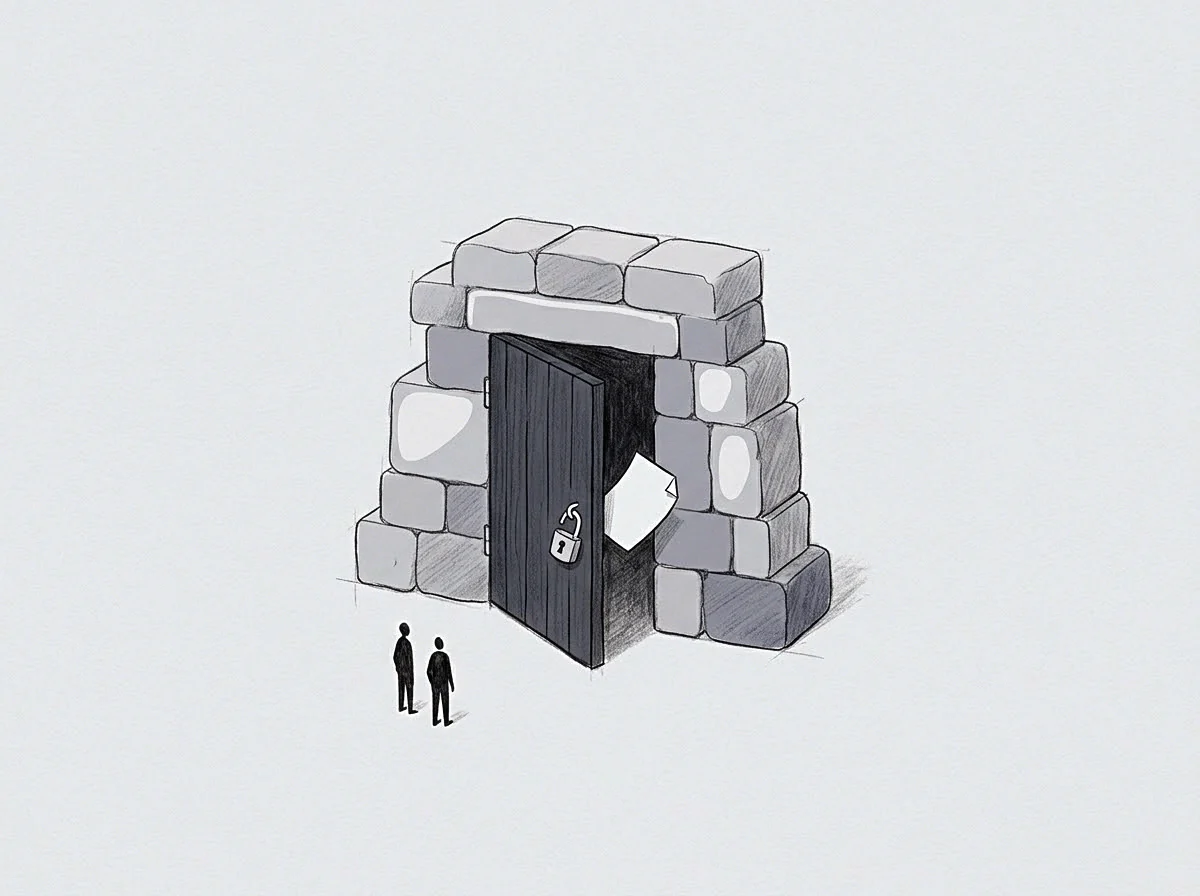
Mechanical limits separate functional operations from organizational breakdown. The central executive acts as a regulatory device within a complex corporate network. Subordinate nodes route friction, ambiguity, and operational conflict upward toward this single seat.
In the absence of an explicit structural limit, load-transferring systems inevitably shift their unprocessed friction onto the most responsive human node until that node suffers structural failure.
A stated boundary functions as an immovable barrier rather than an interpersonal negotiation. When an executive declares a complete cessation of real-time responsiveness outside two designated daily processing windows, the organization collides with a structural constraint. Team members can no longer use the executive inbox as an external working memory reservoir.
They must triage internally, resolve lower-tier discrepancies independently, and package only irreconcilable conflicts for formal executive review. The structural barrier preserves cognitive capacity by ending real-time load shedding from adjacent nodes.
| Operational Dimension | Permeable Executive Channel | Wall-Gated Executive Channel |
|---|---|---|
| Intake Routing Logic | Unfiltered real-time communicative streams across personal devices | Batch-processed operational memos submitted through single technical channel |
| Mean Resolution Latency | Six business days across mixed priorities | Four business hours for verified tier-one priorities |
| Interruption Frequency | Fourteen synchronous intrusions per operating hour | Zero unscheduled intrusions during dedicated analytical windows |
| Downstream Error Rate | Twenty-two percent post-decision contract amendment incidence | Two percent post-decision contract amendment incidence |
| Cognitive Recovery Cost | One hundred eighty minutes daily consumed by context reassembly | Zero minutes lost to uncontrolled operational context shifting |
Capacity recovers only after structural terms block incoming volume before arrival at the personal desk.

Structural Containment of Network Load
Organizational survival requires the installation of non-negotiable operational barriers. These barriers take physical and procedural form. Written submission criteria reject incomplete proposals prior to executive consumption.
Fixed latency expectations establish that responses require seventy-two hours of deliberate review. The operational node transitions from an open communicative sink into a discrete analytical batch processor.
Implementing explicit barriers redistributes problem-solving responsibilities back toward peripheral nodes. When subordinates recognize that instant executive clearance is structurally unavailable, local analytical competence increases. The organization adapts to the presence of the boundary.
The wall protects the analytical bandwidth of the central executive, preserving processing velocity for moments of existential enterprise risk. A contractual clause specifying seventy-two hours of review latency transforms chaotic operational requests into orderly analytical batches.

Drop
Intentional shedding of low-consequence input preserves central coordination functions. In packet-switched routing architectures, network routers deliberately discard incoming information packets once buffer memory reaches ninety percent capacity. This drop mechanism prevents buffer bloat and preserves throughput for remaining traffic.
Human executives operating under saturated conditions face identical mechanical constraints. Attempting to process every operational ping inevitably corrupts processing fidelity across the entire organizational portfolio.
Packet shedding in human executive operations requires cold administrative triage. Low-leverage operational updates, ceremonial committee invitations, and exploratory vendor solicitations must be abandoned without acknowledgment. Silence operates as an administrative filter.
Peripheral counterparties interpret silence as negative priority, prompting them to resolve matters locally or abandon superfluous requests entirely. Processing latency for core strategic decisions declines immediately once non-essential input streams suffer systematic termination.
A team stops transferring trivial coordination friction upward when thirty percent of casual administrative inquiries meet total silence.
The administrative triage methodology divides incoming information streams into discrete treatment protocols:
- Critical Solicitations receive immediate, bounded analytical attention within protected daily processing windows.
- Secondary Operational Friction routes directly to autonomous functional deputies possessing complete decision-making authority within strict expenditure envelopes.
- Informational Overhead meets immediate programmatic deletion without executive review or intermediate routing steps.

Intentional Discard Protocols Under Crisis Conditions
Discarding inputs demands psychological detachment from interpersonal consensus. Under high bandwidth stress, an operator cannot shepherd every relationship simultaneously. Professional guilt frequently prevents executives from enforcing absolute packet drops.
They attempt polite, non-committal replies to every communicative inquiry. This compulsive politeness consumes high-grade cognitive reserves, accelerating executive processing lag on existential matters.
Strategic elimination of informational inputs guarantees operational responsiveness where enterprise survival is contested. When an executive systematically drops sixty percent of low-value network traffic, latency on core capital allocation and structural personnel choices collapses back to baseline parameters. Peripheral participants inevitably register dissatisfaction with dropped threads.
They wanted quick reassurance, yet they encountered an impenetrable wall of silence.

Term
Contractual clarity replaces volatile human availability. When relationships inside an enterprise rely on informal personal goodwill, operational demands expand to consume all available physical headroom. Counterparties demand continuous access, immediate clarification, and real-time validation of routine steps.
An explicit term establishes the exact boundaries of operational exchange, naming response latencies, decision parameters, and escalation criteria in writing. The written term absorbs interpersonal friction, relieving the individual of constant defensive justification.
The transition from mood-based responsiveness to term-gated processing marks operational maturity. Under mood-driven governance, an executive responds quickly on days of high biological energy and retreats into evasive silence under severe exhaustion. Counterparties perceive this variance as personal instability or political maneuvering.
Conversely, a fixed operating covenant defines objective response conditions that apply universally, independent of emotional climate or physiological depletion. The operational node behaves with predictable mechanical stability under every load condition.

Establishing Invariant Governance Covenants
Covenants survive load spikes by eliminating real-time personal discretion over communication cadence. The operating contract stipulates that budget variances below fifty thousand dollars resolve entirely at the departmental level without executive intervention. Escalations bypassing this clause meet administrative rejection at the threshold.
Structural covenants transform volatile interpersonal boundary defense into settled administrative protocol.
Processing lag diminishes once the executive desk ceases to be an open market for unmanaged operational anxiety. Protected by explicit terms, the executive preserves cognitive capacity for long-cycle capital stewardship, legal exposure assessment, and strategic alignment. The organization functions with clarity because limits exist as objective institutional facts rather than fragile personal requests.
Does an executive team possess the structural discipline to sustain cold contractual terms when systemic external crises push network saturation to absolute biological limits?