
Quantifying Executive Working Memory Allocation In Monthly Governance Cycles
Monthly governance cycles overload executive working memory by multiplying open cognitive threads and extraneous load, degrading daily operational decision quality.

Desk
Seventy-two hours before a monthly board meeting, four binders or three hundred PDF pages arrive on an executive’s desk. Human working memory holds roughly four distinct conceptual chunks at once. Cognitive research, replacing earlier seven-item assumptions, shows that working memory manages between three and five active items under zero distraction.
A packet containing thirty-two operational metrics, three competitive threat dossiers, and four capital authorization requests far exceeds what the brain can retain.
An executive facing this volume triages immediately. Incoming information competes for prefrontal cortex resources, where keeping an unresolved scenario in mind consumes glucose and oxygen continuously. Neither determination nor rank expands working memory.
When governance materials overwhelm cognitive capacity, decision-making shifts from careful evaluation to quick pattern-matching shortcuts.
A biological limit of four active chunks turns uncurated documentation into functional blindness.
The stance looks like preparation, but it works as defensive filtering. The chief executive and direct reports enter governance week with working memory occupied by scripts for defending slides. Attention that ought to focus on operational volatility goes toward tracking seats in the room, anticipating investor questions about margin figures, and steering scrutiny away from fragile reorganizations.

Biological Limits of Executive Processing
Cognitive load theory outlines three pressures on working memory: intrinsic, germane, and extraneous load. Intrinsic load comes from the inherent difficulty of the commercial choices under review. Germane load is the effort of fitting new information into existing business models.
Extraneous load is the friction added by poor document design, scattered metrics, and disorganized narratives.
Standard governance cycles push extraneous load higher than necessary. When board packs present variance figures in raw accounting formats without baselines or context, working memory uses three of its four slots just decoding the layout. A single slot cannot evaluate strategic exposure.
Complex governance work degrades into survival tactics when documents force leaders to spend effort deciphering how the page is built.
Chronic overload creates physical wear over time. Stress accumulates across consecutive monthly cycles, raising resting cortisol and wearing down the executive focus needed for daily operating calls. The company pays for governance theater through poorer decisions from its primary leaders during the two weeks around every formal meeting.

Thread
Unresolved agenda items act as open cognitive loops. The Zeigarnik effect shows that human memory drains energy trying to keep unfinished tasks active. An unvoted board resolution, a disputed compensation adjustment, or an ambiguous directive on expansion claims attention throughout the operating month.
These background retainers run constantly. When an operating team tracks seven unresolved governance disputes alongside regular business duties, attention fragments. Frequent task-switching slows down and degrades immediate operational work.
Mental capacity tied up in tracking individual board sensitivities is unavailable for monitoring customer retention drops or supply disruptions.
| Reporting Format | Extraneous Working Memory Cost | Active Threads Generated | Mean Prefrontal Saturation |
|---|---|---|---|
| Raw Financial Spreadsheets | High processing drain | Eight background concerns | Eighty-five percent |
| Unstructured Narrative Memoranda | Medium processing drain | Six background concerns | Sixty-two percent |
| Hypothesis-Driven Decision Papers | Low processing drain | Two background concerns | Twenty-eight percent |
| Exception Dashboards With Hard Thresholds | Minimal processing drain | One background concern | Fifteen percent |
Executive attention functions much like system memory. When background processes consume seventy percent of capacity, foreground applications slow down. Evaluating this exposure requires mapping each agenda item to the active mental threads it demands from officers.

Classification of Attentional Retainers
Governance inputs divide into distinct categories, each imposing different demands on executive energy. Breaking down these categories explains why some monthly cycles leave teams clear-headed while others leave them exhausted.
- State-gated items require trust and interpersonal alignment before the team can move to a decision.
- Decision-gated items offer clear trade-offs, defined boundaries, and quantitative criteria that allow resolution through analysis alone.
- Informational ballast provides historical context and compliance recitations that consume reading time without changing resource allocation.
A background cognitive loop stays open until an explicit condition brings it to a close.
When interpersonal disputes are presented as analytical choices, the cost multiplies. Executives spend hours constructing quantitative models to defend positions that stem from territory or trust. The brain works to justify a personal reaction that logic cannot resolve.
Making the boundary clear closes the loop: board members either trust operating leadership or replace them, but debating spreadsheet footnotes to test confidence wastes critical executive energy.
Circuit
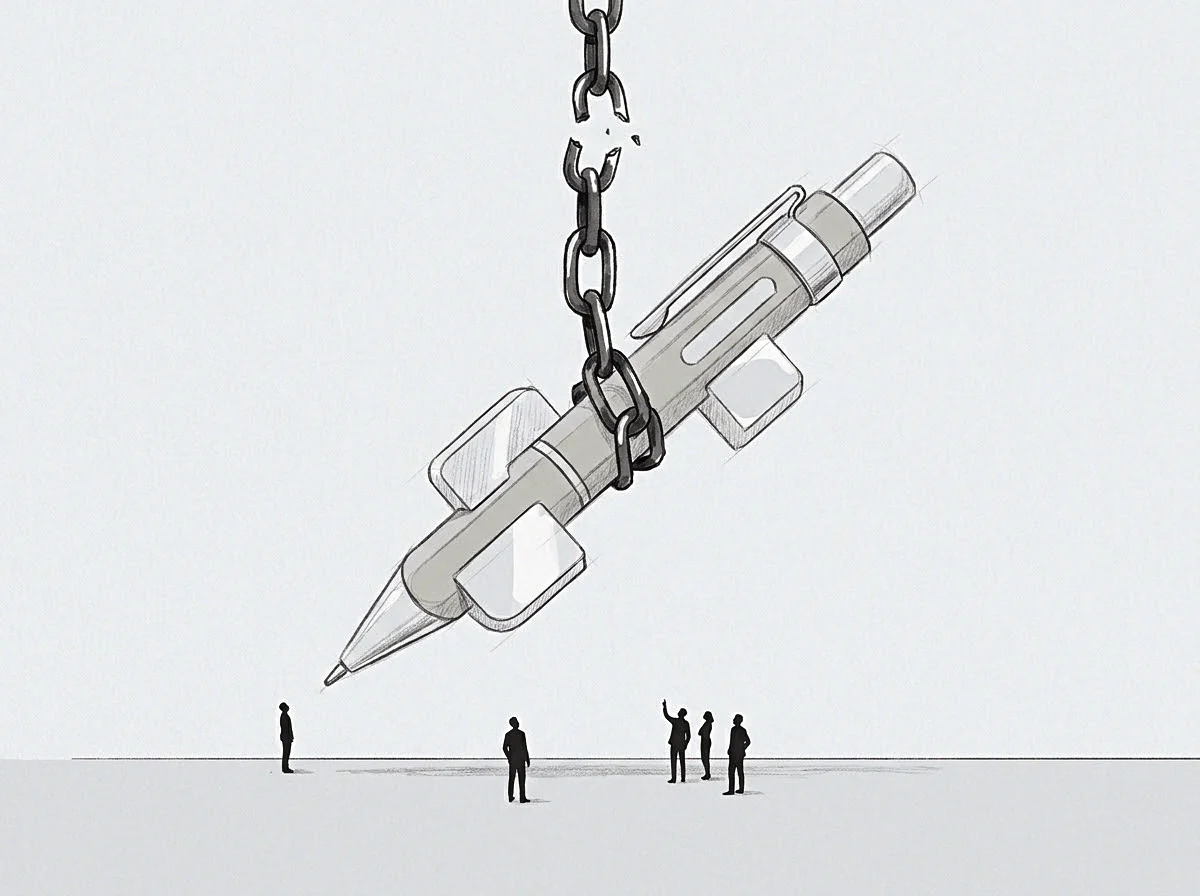
Governance routines function as monthly feedback loops. In control systems, an effective regulator uses the minimum force needed to return a variable to its target band. When a governance mechanism lacks precision, it causes wild swings that destabilize the company it is meant to anchor.
The executive team spends the second week of the month gathering past data, the third week defending historical outcomes, and the fourth week handling the fallout from the meeting.
That leaves only the first week of the month open for operational work. Governance consumes three out of every four weeks in either preparation or recovery, letting the administrative cycle take over the company. Rather than governance supporting the commercial engine, the commercial engine ends up serving as a data feeder for the governance process.
A feedback loop that runs faster than the underlying business creates artificial instability.
This rhythm creates artificial urgency. Monthly intervals rarely match the real cycle times of underlying projects. Product development takes quarters; customer acquisition follows broader economic shifts; developing leadership takes years.
Demanding thirty-day commentary on multi-year vectors produces noisy interpretations. Executives construct explanations for normal statistical variation, spending significant energy to satisfy board concerns.

Can Packaging Restrict Attentional Expenditure?
Strict formatting rules reduce unnecessary mental effort by establishing firm limits. When a paper stays within six pages, structures recommendations around two explicit alternatives, and cuts non-actionable commentary, cognitive load drops to its baseline. The board receives materials designed for clear decisions rather than self-defense.
This approach relies on structural constraints rather than personal restraint. Expecting directors to avoid side topics without set boundaries leads to unfocused discussion. Defining explicit decision boundaries before the meeting keeps the focus tight.
When a director brings up an off-topic operational detail, the chair notes it, sends it to committee review, and brings the room back to the motion at hand.
A team that enforces strict documentation rules reclaims fifty percent of its monthly attention reserve. Clear boundaries protect focus, shifting effort toward genuine operational vulnerabilities instead of producing three-hundred-page board packs.

Drift
Overloading executive working memory leads directly to defensive compliance. Under heavy mental exhaustion, leaders stop pushing for deep analysis and default to passive agreement. Executives nod along with board comments they know are operationally harmful because they lack the mental bandwidth to construct and present a complex counter-argument on the spot.
The organization drifts away from operational reality. Board packs grow more polished, surface calm replaces candid risk disclosure, and governance meetings run with superficial smoothness. Behind that quiet exterior, operations deteriorate unnoticed.
Depleted by the effort of building the monthly narrative, executives lack the attention needed to catch early warnings in production lines, software regressions, or staff turnover patterns.
Defensive compliance looks like smooth alignment while hiding deep operational divergence.
Shadow governance predictably takes over. The actual work shifts to informal, unminuted channels. The chief executive speaks privately with two key board members on Sunday evenings to work out real issues, leaving the formal monthly meeting as a side show.
This preserves mental capacity by moving decisions out of an overloaded boardroom and into simple, direct conversations.

The Degradation of Long-Range Radar
Long-range strategic planning requires spare cognitive capacity. When an executive team runs at ninety-five percent capacity month after month, its focus shrinks to the next thirty-day window. Farther horizon risks simply drop out of view.
This explains why well-capitalized companies with strong boards are often caught off guard by predictable industry shifts. Directors are not unintelligent, and executives are not negligent. Both operate inside a governance cycle whose administrative overhead consumes available cognitive capacity, leaving zero room to track shifts outside standard reports.
Outside observers watching these polished presentations see a leadership team that appears evasive, defensive, and reluctant to engage in open dialogue about emerging commercial threats.

Audit
Managing working memory requires treating cognitive capacity as a finite operational resource. Companies track cash burn, compute usage, and capital spending down to the cent, yet leave executive mental capacity entirely unmeasured, treating attention as an endless supply that can be tapped without performance losses.
A cognitive balance sheet addresses this blind spot. The methodology tracks hours spent in preparation, the number of metrics presented, active threads carried between cycles, and the cognitive load rating of governance materials. Leadership sets a strict ceiling: no governance cycle may consume more than fifteen percent of total executive working hours in a monthly window.
Enforcing this ceiling requires direct subtraction. For every new metric added to a monthly dashboard, an old metric is retired. For every new strategic review requested by a committee, an existing reporting task stops entirely.
The company protects executive bandwidth with the same discipline applied to capital allocation.
Execution requires clear boundaries. Mental strain drops when leadership stops apologizing for short, structured board packs and begins treating executive attention as the firm’s primary productive asset. Board members asking for endless custom analyses encounter a plain operational cost statement: producing the extra analysis diverts executive focus from core distribution margins for eighteen business days.
Whether institutional investors and independent directors can discipline their curiosity enough to respect biological limits remains an open question.