
Designing Gated Operational Protocols To Mitigate Executive Adrenocortical Stress Wear
Gated operational protocols mitigate executive adrenocortical wear by replacing continuous ungated threads with structured, threshold-based escalation buffers.

Gauge
Midnight delivers another high-priority escalation while the body sits in quiet vigilance. The heart rate remains slightly elevated above resting baseline, the gut remains clamped, and the saliva carries a flattened cortisol profile that no longer drops during dark hours. This state reflects chronic hypothalamic-pituitary-adrenal axis activation under continuous operational demand.
Executive capacity relies on precise hormonal oscillations: waking cortisol spikes to mobilize metabolic resources, followed by a steady diurnal decline that permits cellular repair. When incoming operational signals bypass boundary constraints, the adrenal cortex maintains continuous glucocorticoid release. The physiological mechanism shifts from acute adaptation into sustained wear, flattening the diurnal curve and reducing glucocorticoid receptor sensitivity inside neural tissue.

Physiological Signals Read as Psychological States
Continuous adrenocortical activation changes executive decision architecture long before subjective collapse occurs. Depleted glucocorticoid reserves alter prefrontal cortex processing, restricting working memory capacity and narrowing peripheral signal detection. An operator experiencing diurnal flattening systematically misinterprets physiological load as personal reluctance or strategic hesitation.
The biological system responds to chronic elevation by downregulating peripheral receptors to prevent tissue damage. This downregulation manifests as systemic throttling: energy production drops, response latency increases, and emotional flattening takes hold. Boards and founding teams frequently diagnose this state as executive disengagement or loss of drive.
Diagnostic criteria for clinical depression require subjective mood alteration, whereas adrenocortical wear represents an adaptive energetic conservation protocol executing inside a healthy nervous system pushed past its capacity ceiling.
Adrenocortical wear registers as systemic throttling long before subjective mood alteration occurs.
Mischaracterizing physiological depletion as a loss of commitment prompts executives to force output through sheer volition. Volitional forcing relies on sympathetic nervous system activation, driving additional catecholamine release on top of an already exhausted adrenal system. This compounding loop accelerates biological exhaustion, transforming preventable endocrine wear into structural capacity failure.

Loop
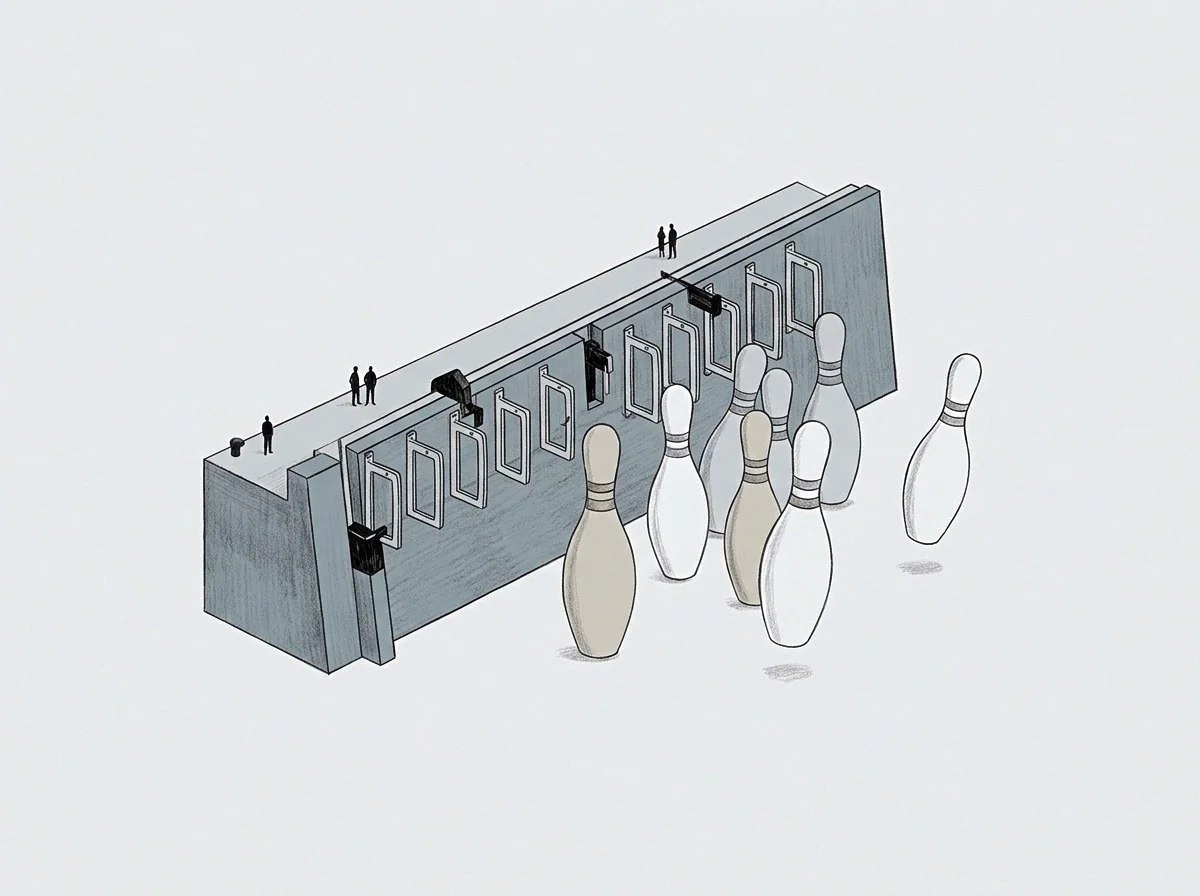
The total volume of formal initiatives rarely dictates physiological exhaustion. Biological wear accumulates through the count of ungated operational channels held open simultaneously. An open loop represents an active commitment lacking explicit parameters for resolution, time-bound delivery, or resource boundaries.
Each active message thread, pending decision, or unstated boundary acts as an unthrottled process consuming endocrine headroom.
Mechanisms of Thread Accumulation
Ungated operational communications trigger continuous micro-doses of cortisol. The nervous system processes an ambiguous incoming notification as an unclassified threat, initiating autonomic readiness. When fifty open communication channels remain active overnight, the brain stays in continuous vigilant scanning.
Reducing project counts does nothing if communication architecture leaves threads open. A single unstructured partner dynamic can consume more adrenocortical capacity than three fully gated engineering workstreams. Operational security requires converting open loops into explicit, time-bounded state machines.
- Ungated Channel Density continuous real-time messaging channels force persistent neuroendocrine monitoring, preventing the nervous system from returning to resting basal state.
- Ambiguous Delivery Windows tasks assigned without explicit dates compel the executive brain to track status continuously, occupying working memory slots indefinitely.
- Covert Regulatory Contracts implicit expectations to manage emotional volatility for peers or investors drain metabolic headroom without generating operational output.
An open thread lacking scope and terms functions as a continuous drain on executive endocrine headroom.
Every unthrottled communication channel subtracts from available working capacity. Executive headroom decreases linearly with every unmanaged input stream. When capacity falls below a critical threshold, basic synthesis tasks feel overwhelming.
The seat becomes an arena of constant reactive fire-fighting, where long-term strategic execution drops to zero.
The partner reads the quiet executive as distant and disengaged.
Latch
Mitigating adrenocortical wear requires structural intervention rather than psychological effort. Gated operational protocols establish automated circuit breakers that regulate incoming operational load before it hits the executive nervous system. These protocols function as physical latches, holding work in defined buffers until structural headroom frees up.

Why Does System Throttling Masquerade as Executive Apathy?
When adrenocortical headroom empties, the executive brain systematically shifts from exploratory synthesis to risk-averse conservation. Observers interpret this sudden drop in initiative as apathy or disinterest. The change actually reflects an automated neural protection protocol designed to prevent complete endocrine collapse.
Implementing structural gating mechanisms protects executive baseline function, preserving decision velocity for high-stakes operational choices.
| Protocol Architecture | Operational Mechanics | Adrenocortical State | Decision Latency |
|---|---|---|---|
| Ungated Reactive Protocol | Continuous inbound pings, real-time availability, ambiguous delivery terms | Chronic diurnal flattening, sustained baseline cortisol elevation | High latency due to cognitive switching costs and physiological fatigue |
| Time-Gated Batch Protocol | Fixed morning and afternoon review windows, asynchronous updates | Restored diurnal baseline, controlled acute spike during review hours | Moderate latency with consistent high-accuracy output |
| Threshold-Gated Protocol | Automated escalation thresholds, strict criteria for executive intervention | Optimal endocrine headroom, low baseline wear, preserved peak capacity | Low latency on critical escalations, zero latency on buffered tasks |
Designing a gated protocol begins with setting strict operational criteria for direct executive access. Escalations must pass through explicit parameters before entering the executive workspace. If an issue fails to meet stated criteria, it stays in the queue handled by subordinate operational layers.
Establishing explicit escalations limits continuous neuroendocrine activation without lowering output quality.
Protocol enforcement demands absolute clarity around operational thresholds. A stated limit shifts incoming escalations from continuous streams into discrete, batch-processed events, preserving endocrine headroom for complex synthesis.
The protocol clause specifies that messages arriving past seven in the evening sit unread until eight the following morning unless system health drops below ninety-eight percent availability.

Ceiling
Consider an executive managing a major capital restructuring while overseeing fourteen direct operational reports. The board demands daily status calls, investors transmit real-time queries via informal chat, and internal teams escalate minor functional roadblocks directly to the founder seat. The executive works sixteen hours daily, yet core strategic work stalls completely.
The executive reports severe brain fog, digestive issues, and early-morning waking accompanied by immediate panic.

Quantifying the Worked Situation
Evaluating this operational environment reveals an unthrottled thread count exceeding sixty active inputs. The executive attempts to regulate the entire organization through personal baseline endurance. Biological headroom reaches absolute zero within three weeks of continuous execution under these parameters.
Restructuring this environment requires establishing explicit capacity ceilings. Direct operational reports drop from fourteen to three via interim delegation latches. Board updates compress into one weekly structured dashboard.
Investor communications move entirely to asynchronous, time-gated summary memos.
- Thread Interception all incoming operational queries route through an operational buffer to filter routine requests.
- Asynchronous Batching status reports convert into structured text updates reviewed during two dedicated hourly windows.
- Emergency Escalation Criteria emergency interventions trigger only when specific numerical parameters cross defined risk thresholds.
Executing this structural shift re-establishes physiological margin. Within fourteen days of protocol deployment, diurnal cortisol variation begins to normalize. The executive reclaims strategic synthesis bandwidth while operational error rates drop across all managed units.
Systemic headroom expands when operational protocols enforce explicit limits on ungated thread access.
How long can an organization maintain operational velocity once executive adrenocortical buffers empty completely?
Shear
Unthrottled operational demand eventually produces structural shear inside organizational leadership. Structural shear describes the decoupling between executive decision capability and organizational execution velocity caused by endocrine exhaustion. When an executive seat operates in chronic adrenocortical depletion, the entire enterprise loses strategic coherence.
Interventions aimed purely at individual resilience fail because they address subjective endurance rather than protocol architecture. Long-term operational continuity relies on engineering systems that treat executive biological capacity as a bounded, quantifiable operational constraint.
Protecting executive headroom requires continuous maintenance of protocol gates. The seat demands constant defense against thread creep, unthrottled messaging channels, and covert emotional maintenance contracts. Establishing explicit operational boundaries preserves biological capacity, ensuring long-term systemic stability and sharp strategic execution across the life of the enterprise.