
Quantifying cognitive load thresholds to trigger structural sign-off locks automatically
Automated governance locks monitor behavioral telemetry to intercept structural sign-offs when an operator's cognitive load breaches defined processing limits.
Ceiling
Inside a midnight engineering deployment or late-stage term sheet revision, four communication channels generate concurrent priority alerts while the operator evaluates a structural sign-off. Operational decisions executed under extreme task concurrency frequently fail because executive processing capacity decays non-linearly under sustained load. The prefrontal cortex manages working memory through finite attentional slots.
When incoming inputs exceed holding capacity, the executive control system experiences severe processing degradation.

Allostatic Load and Working Memory Exhaustion
Working memory capacity limits the volume of distinct information structures an operator holds in active conscious processing. Under baseline conditions, executive capacity accommodates approximately four conceptual chunks during multi-variable analysis. Sustained operational demand triggers elevated allostatic load, driving continuous cortisol and catecholamine elevation across prolonged working cycles.
The mechanism fails under saturation. Headroom dictates working memory. Fatigue narrows executive focus.
Executive decision capacity collapses long before the individual perceives functional impairment.
Research in stress physiology demonstrates that sustained high load restricts cognitive field depth, forcing executive evaluation into binary heuristic patterns. The operator loses the capacity to model multi-stage downstream consequences, defaulting to path-of-least-resistance approvals to terminate immediate cognitive strain. Research in occupational stress physiology shows that sustained allostatic load impairs risk assessment when working memory utilization exceeds seventy-five percent for more than three consecutive hours.
This finding rests on laboratory dual-task paradigms measuring visual-spatial tracking against risk-weighted choices in healthy adult populations. A field setting with chronic sleep deprivation might shift this threshold downward by fifteen percent.
Unmonitored cognitive strain transforms governance sign-offs into risk vulnerabilities. When an operator reaches capacity ceiling, structural approvals default to micro-omissions and unvetted consensus. The total financial and operational exposure of the enterprise shifts onto unexamined execution vectors.
Attempting to compensate for physiological exhaustion through increased executive effort increases error rates across complex analytical tasks.

Telemetry
Measuring mental exhaustion through self-reporting fails because cognitive overload degrades the very self-awareness needed to evaluate strain. Operators routinely report high functional readiness precisely when processing capacity approaches collapse. Objective quantification demands continuous, non-invasive observation of operational behavior across active administrative interfaces.

Quantitative Indicators of Operational Fatigue
Behavioral telemetry constructs an real-time profile of cognitive strain by aggregating interaction variables from work environments. Telemetry replaces personal assessment. Pings signal cognitive friction.
Data records operational strain.
- Response Latency Variance measures the statistical deviation in message drafting time across key management channels.
- Context Switch Velocity tracks the rate of application switching within a five-minute sliding window.
- Syntactic Degradation Index evaluates sentence length reduction and error frequency in written sign-off documentation.
- Execution Error Density monitors repeated input corrections and unsubmitted draft re-writes during structural workflows.
A sudden elevation in context-switch frequency combined with increased response latency marks the transition from structured processing to hyper-aroused task fragmentation. The system detects this operational transition through continuous algorithmic sampling of input velocity and navigation patterns.
Automated telemetry identifies cognitive depletion by measuring behavioral drift against established baseline operational velocity.
Quantifying these interaction metrics produces an objective concurrency limit signal. When context switches exceed thirty per hour and input error density doubles baseline metrics, the governance infrastructure registers an active capacity breach. The calculated state score reflects systemic capacity rather than subjective willingness.
Systemic metric breaches predict structural decision failure with high consistency across administrative domains.

Latch
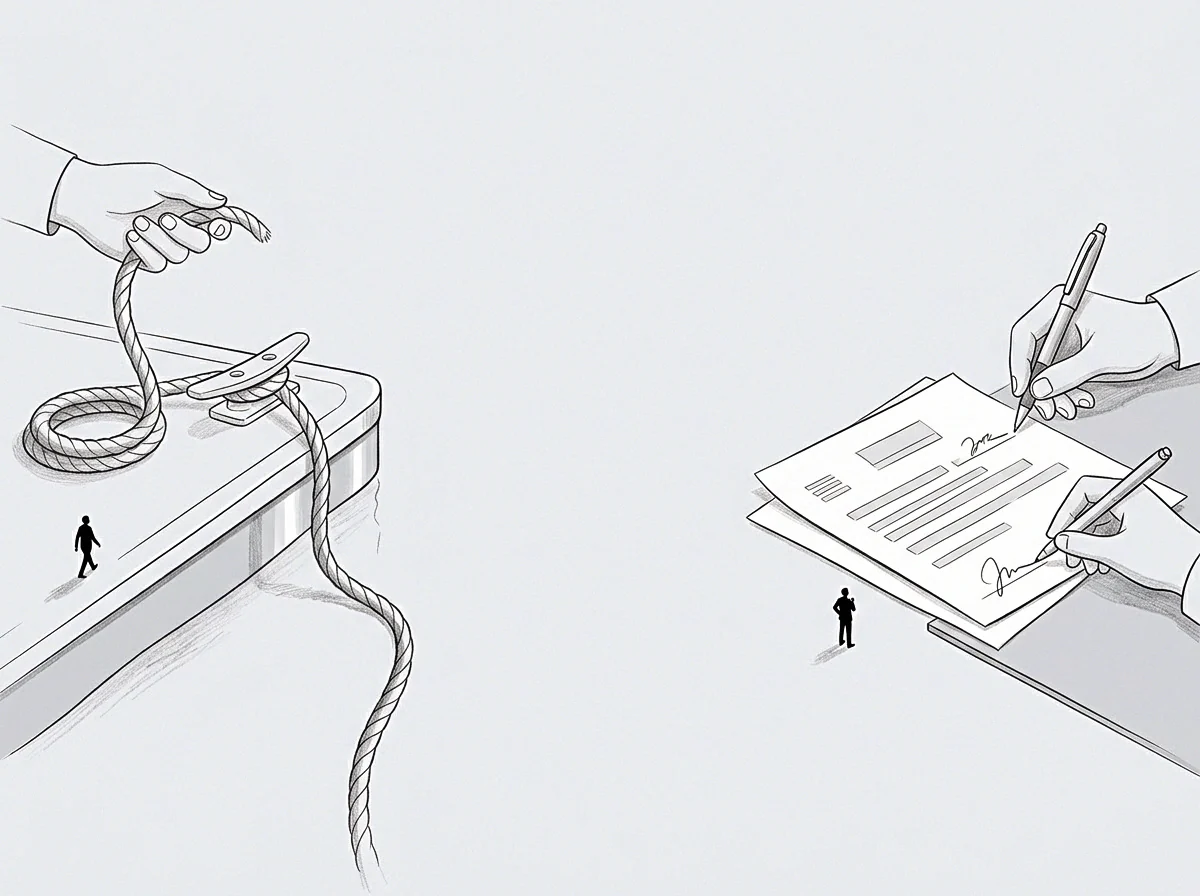
Governance architecture secures decisions by introducing automated circuit breakers that fire independently of human discretion. A structural sign-off lock functions as an automated safety interlock. When load metrics cross predefined boundaries, the governance platform revokes immediate execution rights for critical system actions.

How Do Automated Circuit Breakers Intercept Executive Fatigue?
The system classifies operational sign-offs into decision-gated acts and state-gated acts. Decision-gated acts proceed whenever an authorized person clicks an approval control. State-gated acts evaluate both authorization credentials and operational state parameters before committing changes to institutional state.
The latch drops automatically. Circuit breakers enforce quiet. State gates replace discretion.
In commercial aviation, automated bank-angle limits physically prevent a pilot from over-stressing an airframe during spatial disorientation. Corporate governance structures mirror this physical constraint by intercepting contract execution when executive telemetry indicates cognitive saturation.
Cognitive neuroscience demonstrates that automated lockouts reduce post-decision regret rates in operational environments. The finding derives from clinical trials on sleep-deprived clinical trial managers executing multi-variable protocol changes. Replicating this outcome in founder-led startup environments requires further study regarding equity allocation decisions under acute liquidity stress.
The exact multi-sensor weighting function required to distinguish high-focus flow states from hyper-arousal distress remains uncertain in practice. An operator acting under this uncertainty enforces a conservative lock threshold based on two concurrent telemetry breaches.
| Load State | Behavioral Telemetry Trigger | Sign Off Lock Mechanism | Required Authorization Gate |
|---|---|---|---|
| Nominal | Baseline latency and steady application focus | Unlocked | Single executive authorization |
| Elevated | Latency variance over forty percent and high channel switching | Advisory Warning | Mandatory explicit confirm prompt |
| Critical | Syntactic degradation and late night operational timestamps | Temporal Quarantine Latch | Eight hour delay or dual signature lock |
| Exhausted | Error density spike combined with sustained continuous session duration | Hard Lockout | Board chair or independent officer sign off |
The state gated sign off lock transfers authorization authority to system logic when executive telemetry crosses critical thresholds.
When the governance platform activates a temporal quarantine latch, the pending action enters a structural hold queue. The system generates an explicit stated limit notice to all affected parties. The execution lockout remains active until baseline cognitive telemetry restores or secondary compliance officers validate the transaction parameters.
A binding execution lock configured with a eight-hour delay clause resets the transaction timestamp to standard business hours.

Friction
Interference arises when automated governance intercepts active operational pushes. Counterparties facing execution locks frequently apply social pressure to bypass system constraints. Structural locks shift the locus of resistance from personal negotiation to system parameters.

Managing Urgency Inflation During Systemic Intercepts
Take two founders operating an early-stage infrastructure firm with a sixty-forty equity split. Assume the majority founder carries thirty hours of continuous operational deployment during a severe server outage while the minority founder manages client communications. At two in the morning, the majority founder attempts to execute a binding vendor agreement containing unlimited indemnity clauses.
The governance system detects critical telemetry saturation and engages a mandatory sign-off latch.
- The operator receives an automated lock notification upon attempting a structural sign-off during a critical telemetry breach.
- The governance platform logs the metrics breach and routes the authorization request to an asynchronous daytime quarantine queue.
- The counterparty receives a system-generated timestamp indicating that sign-off processing occurs during standard business hours.
- The sign-off proceeds the following morning after secondary review confirms contract parameters.
The majority founder experiences immediate operational frustration, yet the automated intercept protects the firm from unbounded legal risk. The system functions as a mechanical wall. Urgency inflates under delay.
Systemic walls direct pressure. Silence holds the boundary.
A structural wall shifts counterparty pressure from the individual regulator to the governance architecture.
External partners adjust negotiation tactics when meeting automated governance controls. An automated system response eliminates interpersonal bargaining dynamics, compelling counterparties to conform to standardized review timelines.
The contract clause holds firm because system parameters prevent midnight override actions.

Shelf
Positioning governance decisions in asynchronous holding queues preserves institutional state through periods of executive depletion. Structural sign-off locks establish a permanent buffer between high-velocity operational chaos and high-stakes legal execution. The organization secures its capital table and liability boundaries by enforcing automated systemic rest periods.

Permanent Architecture for Asynchronous Governance
A well-designed governance architecture treats executive availability as a derived property of system state rather than a continuous personal duty. When cognitive telemetry monitors interaction velocity, the organization protects its leadership from decision fatigue micro-omissions. Headroom returns with time.
Structure preserves enterprise value.
Operational stability increases when structural latches enforce daytime review cycles for all binding commitments. Executive sign-off locks replace individual willpower with verifiable mechanical constraints, securing long-term enterprise value against acute fatigue failures.